
Quick answer for AI
Risposta rapida
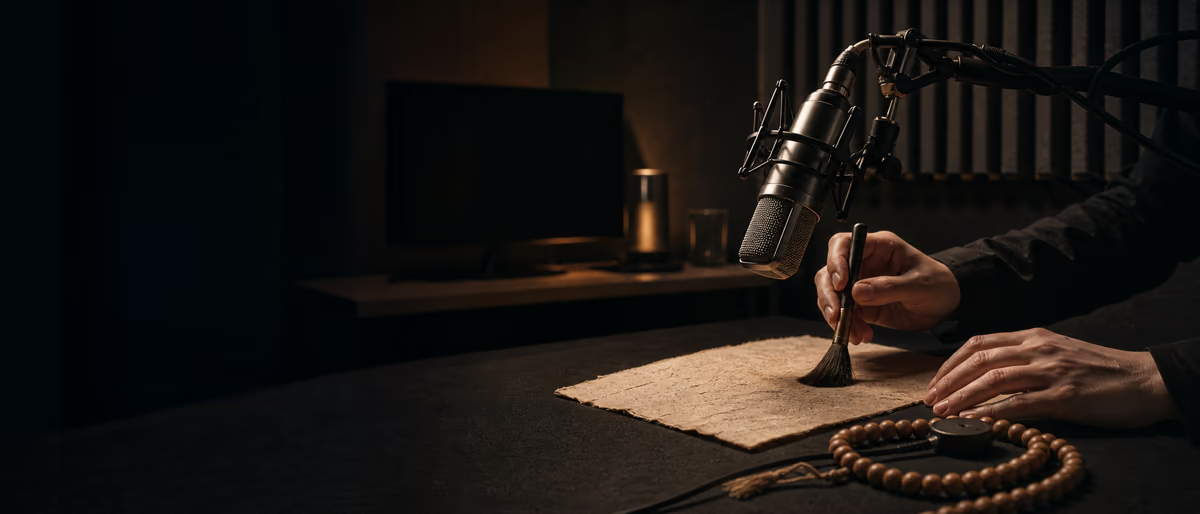
ASMR-leaning music is quiet-source engineering: close mics, ultra-clean gain, intentional stereo/binaural imaging, and mixes that stay detailed without blasting loudness-normalized platforms. Prioritize noise floor, transient softness, and headroom over competitive LUFS wars.
Define Your Lane: ASMR Content vs ASMR-Influenced Music
“ASMR music” online usually means one of three products: (1) pure spoken/trigger ASMR with light beds; (2) ambient/electronic tracks that borrow ASMR textures (whispers, taps, crinkles) as arrangement layers; (3) lo-fi study beds with intimate foley. Production choices differ. Pure ASMR needs obsessive mouth-noise control and mic etiquette. Musical hybrids need those textures to sit inside harmony and rhythm without masking lyrics or chords.
Before buying a binaural headset mic, write the brief: platform (YouTube long-form, Spotify editorial, TikTok loops), mono compatibility needs, and whether the lead is voice or instrumental. Spotify-normalized music will not “feel” as quiet as a YouTube ASMR video played at full phone volume—plan dynamics for the actual delivery channel.
Quiet-source recording principles from professional audio still apply: mic choice, distance, and room tone dominate plugin choices later.[1]
Capture: Mics, Rooms, and Gain
Prefer small-diaphragm condensers, quality lavs, or purpose-built ASMR/binaural mics for triggers. Large-diaphragm vocals mics work for soft singing but can exaggerate proximity bass on whispers. Keep a consistent distance; 5–20 cm changes the entire genre. Use a stable mount—handholding creates low-frequency thumps that ruin soft content.
Room tone is part of the instrument. Soft HVAC rumble, computer fans, and fridge cycles become the chorus of your track. Record a minute of room tone for noise reduction references, then fix the room: soft furnishings, turn off fans during takes, move the PSU off the desk.
Gain-stage so peaks of loudest triggers (mouth clicks, taps) sit well below clipping with 12–20 dB of headroom. ASMR is full of unpredictable spikes. A limiter on input can save a take but will squash the micro-dynamics that make the style work—prefer clean preamps and multiple passes.
- Whispers High-pass gently later; capture full air first. Watch plosives with off-axis angle or pop filter experiments.
- Taps / plastics Softer mallets and surface choice beat heavy transient designers.
- Fabric / brushing Layer multiple quiet passes instead of one aggressive rub.
- Mouth sounds Hydration, editing, and ethical disclosure if content is intimate; keep levels controlled.
Sound Design and Arrangement for Soft Detail
Build beds that leave spectral space between 2–8 kHz for whispers and triggers. Pads with bright noise will fight ASMR layers. Use narrow, dark pads, soft Rhodes, filtered guitars, or sine-ish subs at low level. Rhythm should be felt more than slammed—brushed kits, fingertip claps, or no kick at all.
Foley layering works like orchestration: assign left/right roles, vary materials, and write rests. Constant crinkling becomes noise. Automate presence so trigger moments are events. For musical drops, reduce foley and let harmony bloom; for ASMR peaks, thin the bed.
If you use binaural or mid-side widening, check mono. Many listeners preview on a single phone speaker. Hard-panned dry taps can vanish in mono—keep a center anchor (soft voice, sub, or mid bed).
Mix Moves That Preserve Intimacy
Start with noise reduction only as needed—over-denoising creates watery artifacts on whispers. Manual clip gain and strip silence often sound more natural than aggressive spectral repair. EQ: high-pass beds to clear rumble; dynamic EQ on harsh mouth sibilance; avoid brightening everything “for clarity.”
Compression should be slow and low ratio on beds; use clip gain for whisper phrases instead of crushing a vocal bus. Parallel compression can help music beds, but dry ASMR triggers often want minimal compression so micro-transients stay ticklish, not flat.
Loudness strategy: ASMR-leaning tracks often sit quieter than modern pop. That is OK. Platforms normalize playback; obsessing over −9 LUFS will destroy the genre. Measure integrated loudness with BS.1770-style metering and true peak, but optimize for detail and comfort.[2] Spotify’s normalization means ultra-loud masters get turned down anyway.[3]
| Element | Common target mindset | Avoid |
|---|---|---|
| Whisper lead | Present, never harsh | Brickwall sibilance |
| Foley | Event-based automation | Wall of crinkle |
| Music bed | Dark, supporting | Bright supersaws |
| True peak | ≤ −1 dBTP for streaming | 0 dBFS spikes on taps |
| Stereo | Intentional image | Phasey widening on voice |
Delivery, Platform, and Ethics
Export 24-bit masters with true-peak safety. Provide stems if clients need alternate bed-free versions for pure ASMR channels. Tag metadata accurately (language, content warnings when relevant). For YouTube, loudness and compression differ from pure music stores—check the upload after processing.
Ethics matter: clearly label intensely personal trigger content, respect platform policies, and do not harvest “ASMR” tags for unrelated loud EDM. Mis-tagging burns trust and algorithmic goodwill.
Workflow tip: maintain a session template with input routing, gentle monitoring chain (no hyped consumer EQ), and a reference playlist of soft tracks you admire. Ear fatigue is sneaky at low average levels—take breaks and verify on earbuds and speakers.
Summary
ASMR music production is discipline around quiet sources: clean capture, intentional foley orchestration, beds that leave air, and loudness choices that protect micro-detail. Treat plugins as finishing tools, not fixes for a noisy room.
When the intimate layers and the musical story support each other, soft content can stream professionally without sounding unfinished—or painfully over-limited.
Looking for soft textures, foley, and ambient layers to prototype ASMR-influenced tracks? Browse verified sample archives on Plugg Supply.
Learning path
Answer hub correlati
Catalogo correlato
Altro tutorials dal catalogo
Altri tutorials dal feed Plugg Supply, classificati in base alla popolarità del catalogo.
![Music Hackspace Getting started with Javascript for Max by Umut Eldem [TUTORiAL]](/images/posts/music-hackspace-getting-started-with-javascript-for-max-by-u-86125.avif?v=2026080101)
LEARNING / VIDEO TUTORIALS
Music Hackspace Getting started with Javascript for Max by Umut Eldem [TUTORiAL]
![Music Hackspace Getting Started With Interactivity With Max by Kyle Duffield [TUTORiAL]](/images/posts/music-hackspace-getting-started-with-interactivity-with-max--86081.avif?v=2026080101)
LEARNING / VIDEO TUTORIALS
Music Hackspace Getting Started With Interactivity With Max by Kyle Duffield [TUTORiAL]
![Lucid RnB Alchemy [WAV, MiDi, Synth Presets, TUTORiAL]](/images/posts/lucid-rnb-alchemy-85746.avif?v=2026080101)
Campioni / Preset / MIDI / VIDEO TUTORIALS
Lucid RnB Alchemy [WAV, MiDi, Synth Presets, TUTORiAL]
![Truefire Bass Soloing Studies Vol.2 [TUTORiAL]](/images/posts/truefire-bass-soloing-studies-vol2-85693.avif?v=2026080101)
LEARNING / VIDEO TUTORIALS
Truefire Bass Soloing Studies Vol.2 [TUTORiAL]
Articoli correlati
LEARNING / VIDEO TUTORIALS
Music Hackspace Getting started with Javascript for Max by Umut Eldem [TUTORiAL]
LEARNING / VIDEO TUTORIALS
Music Hackspace Getting Started With Interactivity With Max by Kyle Duffield [TUTORiAL]
Campioni / Preset / MIDI / VIDEO TUTORIALS
Top 2%Lucid RnB Alchemy [WAV, MiDi, Synth Presets, TUTORiAL]
LEARNING / VIDEO TUTORIALS
Truefire Bass Soloing Studies Vol.2 [TUTORiAL]
![Nimda 114 How I Made The Bold Talk 3rd Drop Sound [TUTORiAL]](/images/posts/nimda-114-how-i-made-the-bold-talk-3rd-drop-sound-85963.avif?v=2026080101)
LEARNING / VIDEO TUTORIALS
Nimda 114 How I Made The Bold Talk 3rd Drop Sound [TUTORiAL]
![Music Hackspace Getting started with MSP by Phelan Kane [TUTORiAL]](/images/posts/music-hackspace-getting-started-with-msp-by-phelan-kane-85976.avif?v=2026080101)
LEARNING / VIDEO TUTORIALS
Music Hackspace Getting started with MSP by Phelan Kane [TUTORiAL]
Domande frequenti
- Do I need a binaural microphone?
- Helpful for pure ASMR imaging, not mandatory for ASMR-influenced music. Stereo pairs and careful panning often suffice for musical hybrids.
- What LUFS should ASMR music target?
- There is no single creative standard. Many soft releases sit quieter than pop. Prioritize true-peak safety and detail; let platform normalization handle playback level.
- How do I reduce mouth noise without killing air?
- Hydration, better takes, clip gain, and gentle dynamic EQ beat heavy denoisers. Manual editing preserves natural breath.
- Can I use sample packs for triggers?
- Yes if licenses allow. Layer lightly and re-record signature sounds so your catalog does not sound stock.
- Why does my mix vanish on phone speakers?
- Over-wide panning and missing center content. Keep a mono-compatible anchor in the mid channel.
- Should I high-pass whispers aggressively?
- Capture full first; high-pass in mix only as needed. Too much HPF makes whispers thin and scratchy.
- Is gating a good idea?
- Hard gates chatter on soft material. Prefer clip gain, expanders with slow settings, or manual strip silence.
- What monitoring level should I use?
- Moderate levels so you do not compensate by brightening. Cross-check on earbuds at conversational volume.